

Living in another country: cultural navigation
Learning to live in a new place. Because when I think of it, it is learning.
Your senses are heightened. You are assimilating new information, new patterns of behaviour, new ways of thinking. And like all learning it’s tiring. Like a lot of learning it’s confusing at first. And like some learning it’s very rewarding.
Finding a hairdresser, the place where you go to get clothes pegs, the place you go to get clothes! These things that we take for granted when we live in our own culture, that suddenly when you live somewhere else you have to start from scratch and learn about EVERYTHING you do.
I am a great fan of the steps of learning (I was a teacher in another life after all!) …how we move from unconscious incompetence to unconscious competence…and I was reminded of this when talking with a friend who has recently moved here. I was reminded of how tiring cultural navigation can be.
When you don’t speak the language and you are using your senses in a heightened way…not only for the language, but trying to grasp every sense of meaning from every piece of information coming to you from body language and gestures, as well as cultural norms.
Cultural norms are more obvious when you live in a country with a different language, because culture and language are inextricably linked I think. But culture goes beyond language. It’s embedded in the thinking, the humour, the way people walk on the street. It’s in the small things such as either paying for your drink at the time you order it, or when you leave. It’s realising that your idea of personal space is very different from the old woman standing behind you so close you can feel her breath on your arm. It’s in the way you greet people-with a handshake or a kiss…and how many?
It’s a little like a jigsaw puzzle.
And then one day it stops being as tiring, some of the pieces of the puzzle fit together and you move to the next stage of learning.
It can be exciting and invigorating…but also hard work. Because you are always on some level of alert, always observing, watching out, putting the pieces together. And I am reminded of this when I return to New Zealand because it is the exact opposite. I don’t need to watch out or observe, or learn because I get it. I know it. It’s as natural as breathing. The part of me that is always trying to understand cultural context has a holiday! Until the point it reverses and I recognise that some of my ways of being have become Spanish!!! Reverse culture shock…but that’s a post for another day.
I wonder if this is why we experience homesickness? I was talking about this with another friend and the word used for this in Spanish (morriña) is not actually Spanish but comes from Galica-a region in the northwest of Spain- where a lot of people migrated to other countries during the civil war. Is homesickness merely a need/want for the familiar? To be surrounded by comfort…not only of the physical kind but the cultural kind?
There is something (personally speaking!) very liberating about living in another culture…the freedom from your own cultural norms, the freedom to reinvent yourself, the freedom to live as you want to without expectations; self -imposed or otherwise. Are these the exact same things that make up the challenges as well?
Learning to live in another country: ups and downs, highs and lows, relishing the unfamiliar and longing for the familiar.
But, I believe, above all, allowing you the opportunity to reflect on who, what, why and where you are in life.
What an opportunity!
Enter a caption
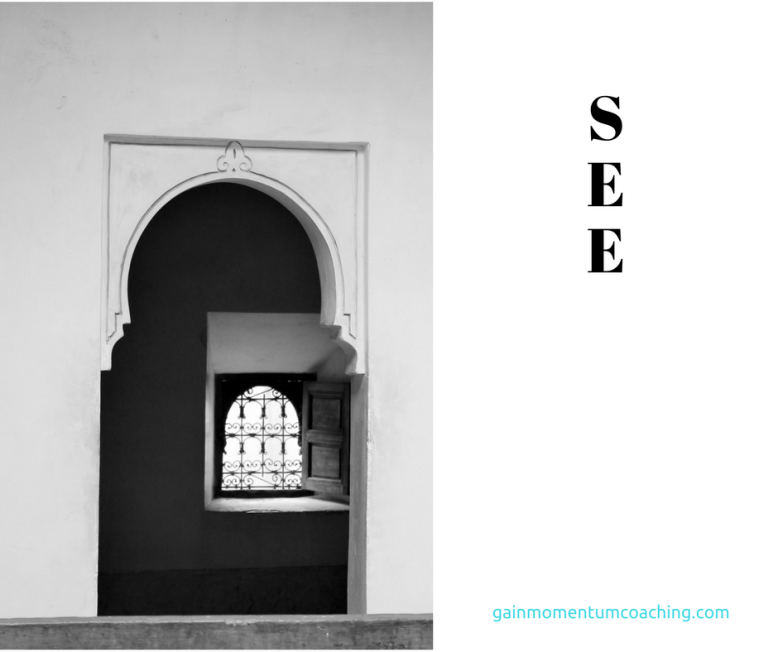
My intention when creating this visual had been to use the word ‘seek’. But when I saw(!) see, I thought I would stop. It led me to thinking about what the difference between seeing and seeking is. Is it a matter of perspective?
If you shift your perspective to seeing rather than seeking, do your thoughts change?
Think about what you are seeking in your own life. Is it more time? More organisation? More money? More love? More clarity? More respect? What if cultivating a practise of seeing rather than seeking helped you notice where the things you are seeking already exist in your life?
When you can see and recognise and notice then your perspective begins to change.
What do we need to do to see? To recognise? To notice? It could be something as simple as taking a step back, walking away and coming back ten minutes later. Or standing in a different place. Or cleaning the windows! When I was writing up my final NLP work, I would sometimes change the size of the font and page format so I’d literally see my answers differently. Something as simple as that can help you change perspective. And once your perspective changes, it opens a window to a different view. Like the wordless picture book Zoom by Istvan Banyai; every turn of the page has you recognising and noticing from a different perspective.
Do you feel like you’d like a different view? Does your perspective limit? Are you seeking where you want instead to see? Or you’re not sure about what you are seeking? Coaching can be the perfect way for you see what is in front of you more clearly and give clarity to what exactly it is you are seeking. Feel free to contact me to see how!
 Gain Momentum Coaching